

CONTRIBUTORS

Robert O. Abad
Western Asset
This past weekend, Colombian voters elected right-leaning Abelardo de la Espriella as the country’s next president, adding to a series of election results investors are watching closely across Latin America. Recent votes in Costa Rica, Chile and Peru have also produced more conservative outcomes, raising the possibility that the region may be entering a new political phase. Brazil’s presidential election in October will be the key test.
What’s striking is that the underlying concerns are similar across countries. Latin America has spent much of the past two decades moving between left-leaning and market-oriented governments, often in response to changing economic conditions. Today, voters across much of the region are focused on security, growth, inflation and government effectiveness. For investors, the election is only the starting point. What matters next is fiscal policy, regulation, energy development, infrastructure investment and the treatment of private capital.
Exhibit 1: Recent Election Results Across Latin America (2023-2026)
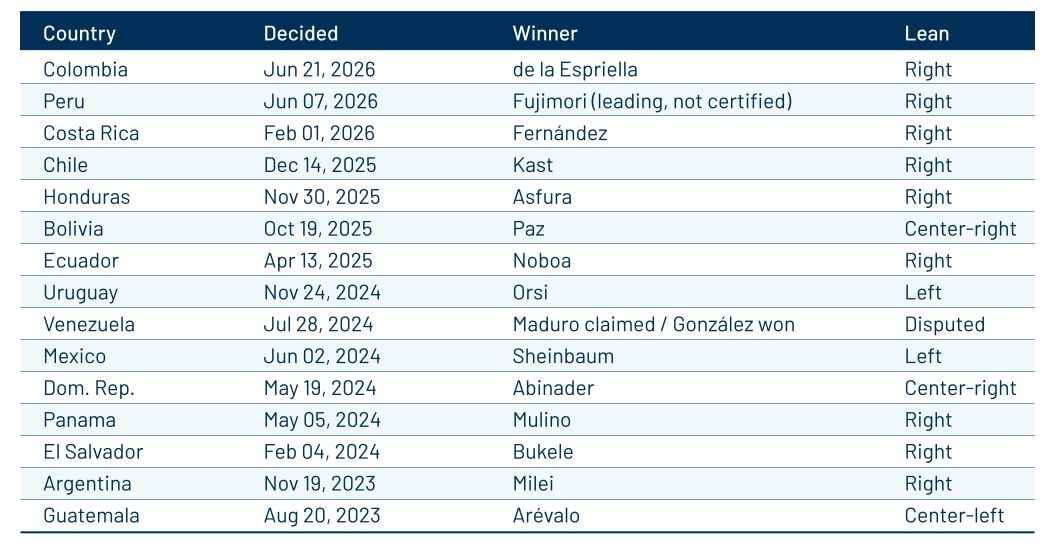
Source: Western Asset. As of June 24, 2026. Compilation based on national election authorities, official election results and public reporting.
Recent experience suggests that local equity, currency and fixed-income markets often react less to ideology than to expectations around policy. Argentina is one example. Argentine assets responded positively following the election of Javier Milei as investors focused on fiscal reform, deregulation and efforts to stabilize the economy. In contrast, Chile and Colombia experienced periods of market volatility when investors became concerned about the potential impact of policy changes on growth, investment, fiscal balances and private-sector activity, although many of those reactions moderated as governments moved from campaigning to governing. The broader lesson is that investors tend to reward clarity, predictability and fiscal discipline regardless of whether a government is viewed as left- or right-leaning.
Brazil will matter most later this year because, as the region’s largest economy and equity market, its election is likely to shape how investors think about Latin America overall, especially as many continue searching for opportunities beyond the small set of themes that have dominated markets in recent years. That search is taking place against a backdrop where Latin America represents only a small share of most emerging market (EM) equity benchmarks, while the bulk of index exposure remains concentrated in Asia.1
It’s important to note that much of the enthusiasm surrounding EM equities has been tied to AI, semiconductors and related themes that have favored several of Asia’s largest markets, particularly Taiwan and South Korea. Latin America has largely sat outside that conversation, despite being home to many of the resources tied to those themes, including copper for electrification, critical minerals for energy systems and infrastructure linked to rising power demand.2
None of this guarantees a surge of capital into Latin America. US foreign policy, a more hawkish Federal Reserve, a stronger US dollar and geopolitical developments remain powerful drivers of capital flows, and history suggests that external conditions often matter more than domestic politics when investors decide where to allocate capital. Even so, after several years when investor attention was directed elsewhere, Latin America’s political cycle is back in focus, and the region may be harder for investors to ignore in the months ahead.
Endnotes
-
The MSCI Emerging Markets Index spans 1,205 companies and 24 countries, but more than 80% of its weight is concentrated in Asia (Taiwan, South Korea, China and India), while Latin America represents less than 10% of the benchmark (Brazil is 3.9%). Source: MSCI Emerging Markets Index Factsheet, May 2026.
-
Latin America holds an estimated 46% of global lithium reserves and more than 36% of global copper reserves. Source: J.P. Morgan, Latin America in 2026: Between Promise and Pressure, the Answer Is Optionality, January 2026.
WHAT ARE THE RISKS?
All investments involve risks, including possible loss of principal.
Fixed-income securities involve interest rate, credit, inflation and reinvestment risks; and possible loss of principal. As interest rates rise, the value of fixed income securities falls.
Commodities and currencies contain heightened risk that include market, political, regulatory, and natural conditions and may not be suitable for all investors.
Diversification does not guarantee a profit or protect against a loss.
International investments are subject to special risks, including currency fluctuations and social, economic and political uncertainties, which could increase volatility. These risks are magnified in emerging markets. Investments in companies in a specific country or region may experience greater volatility than those that are more broadly diversified geographically.
WF: 11127859