
CONTRIBUTORS

Sonal Desai, Ph.D.
Chief Investment Officer,
Franklin Templeton Fixed Income
The unprecedented nature of the COVID-19 economic disruption has made traditional gauges of economic developments woefully inadequate, says our Fixed Income CIO Sonal Desai. She highlights the need to look deeper into new ways of examining the path toward recovery through people’s attitudes and actual behavioral response to this crisis measured via a new study Franklin Templeton is undertaking with Gallup.
Six months into the pandemic-driven disruption of our lives and the economy, we have learned a lot; but, in many ways, we face greater economic uncertainty than we did back in March.
Since June, activity data have shown that the US economy can still stage a strong rebound. Non-farm payrolls surprised on the upside for two consecutive months, bringing back nearly 7.5 million jobs. Weekly jobless claims dropped sharply, retail sales bounced and consumer sentiment recovered in June. High-frequency indicators like the Google mobility index and OpenTable reservations confirmed a brisk rebound in activity.
Consumer Expectations and Economic Surprise Index
January 1, 2007–July 17, 2020
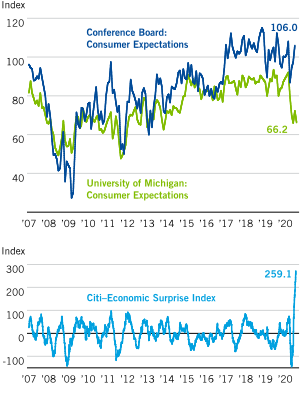
Sources: Franklin Templeton Fixed Income Research, Citi, TCB, University of Michigan, Federal Reserve Bank of New York, Macrobond. There is no assurance that any estimate, forecast or projection will be realized. Indexes are unmanaged and one cannot directly invest in them. They do not include fees, expenses or sales charges. Past performance is not an indicator or a guarantee of future results.
United States: Google Mobility, Homebase Employment and OpenTable Reservations (% Year-over-Year)
February 15, 2020–July 14, 2020

Sources: Franklin Templeton Fixed Income Research, Google, Homebase, Macrobond.
New COVID-19 cases have also risen again, however. This in part reflects more testing, but the positivity rate—the share of new tests that turn out positive—has also risen. The good news is that compared to the first wave of contagion, fewer of those infected appear to need hospitalization and intensive care, and hospital stays seem to be shorter. This is in part because less-vulnerable people account for a larger share of the new cases (many are younger), and partly because hospitals have gotten better at treating COVID-19 patients.
This second wave of contagion, however, threatens to derail the economic recovery. California has already re-instituted a full lockdown, ordering counties to close most indoor activities, and other states have halted or reversed the easing of restrictions. A preliminary reading of the July Michigan consumer confidence index shows a drop after two months of recovery.
Going forward I see three “known unknowns” that will determine how the recovery unfolds:
- Progress toward a vaccine: a few front-runners have already emerged, and a government- private sector collaboration (ambitiously dubbed “Operation Warp Speed”) has accelerated the usual timeline of development and production. A vaccine under development by AstraZeneca and Oxford University has just been shown to successfully trigger an immune response, and AstraZeneca says it could manufacture billions of doses; parallel efforts by US biotech firm Moderna and by a team of Pfizer and Germany’s BioNTech are in relatively advanced stages. Experts believe a vaccine might be ready in 12–18 months.
- Policy decisions: whether different US states and counties will go back into a full lockdown or try to implement a more targeted strategy, now that we have a better understanding of how the virus spreads and how different segments of the population are more or less at risk.
- People’s behavior: how quickly and under what conditions people are willing to go back to their former activities, and spending and working habits.
These three factors are, of course, inter-related. People’s behavior is influenced by policy restrictions, benefits and incentives. In turn, policymakers’ decisions are impacted by the degree to which people are afraid of contagion, eager to go back to work or shopping, and are ready to comply with safety recommendations. Additionally, progress towards a vaccine will impact both policy decisions and individuals’ attitudes.
To get a deeper insight into these dynamics, we are launching a new Franklin Templeton-Gallup Economics of Recovery Study in collaboration with Gallup.
We will conduct a monthly survey to assess a wide range of behavioral and economic factors, including under what conditions people would be ready to go back to their previous spending habits and patterns of behavior; to what extent they support the reopening of specific activities; how they have been impacted by the virus in their everyday behavior and economic prospects.
We will combine the results of this large-scale survey with high-frequency activity data to better understand how economic activity will respond in the coming months, what the “new normal” will look like once the situation stabilizes, and the short-term and long-term implications for financial markets and investment strategies.
While much of the existing analysis and discussion centers on the dynamics of the pandemic itself—too often with a narrow focus on the number of new cases—the attitudes of individuals play an equally important role in the economic recovery, if not even more decisive.
And, people’s attitudes don’t just depend on the dynamics of the virus: In a recent study, Gallup Chief Economist Jonathan Rothwell and Professor Christos Makridis of Arizona State University find that political affiliation is the primary driver of people’s response to the pandemic: the extent to which they are worried about the virus and willing to go back to work or to shop, depends largely on whether they identify as Democrats or Republicans. This is somewhat discouraging, and our research will track whether political affiliation continues to play a dominant role, or whether better information on health care and economic developments will carry an increasing weight.
A V-shaped recovery could still happen; so could a new great depression. The stakes are higher than ever, and so is the uncertainty we face. The unprecedented nature of this economic disruption has made the traditional gauges of economic developments woefully inadequate. So, together with Gallup, we’re rolling up our sleeves to find out what’s happening and what lies ahead.
Our first results will be in soon—stay tuned for the highlights and some new analysis.
WHAT ARE THE RISKS?
All investments involve risks, including possible loss of principal.
The companies and/or case studies shown herein are used solely for illustrative purposes; any investment may or may not be currently held by any portfolio advised by Franklin Templeton. Past performance does not guarantee future results.