

CONTRIBUTORS

Francis Gannon
Co-Chief Investment Officer, Managing Director
The earnings prospects for many small-cap companies remain promising and unrecognized, specifically those for businesses with sound fundamentals, such as low-debt balance sheets, positive cash flows, and the ability to pass on higher costs in this inflationary period.”
For some time, we have posited the idea that a regime change based on market capitalization is on the horizon. Our argument has been that small-caps, which have trailed their large-cap siblings for more than a decade, would return to their more historically typical position of performance leader.
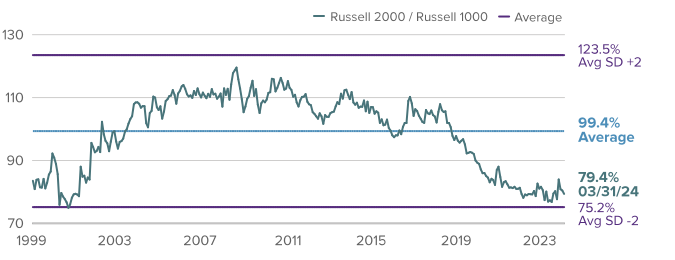
We have also shown that, based on our preferred index valuation metric of enterprise value to earnings before interest and taxes, or EV/EBIT, relative valuations for small-cap versus large-cap are near their lowest in 25 years. In addition, the three-year average annual total return for the Russell 2000 Index as of 4/30/24 was -3.2%—and the small-cap index has had a negative three-year return only six times since its inception more than 40 years ago in 1979. Lastly, the Russell 2000 was -16.2% below its prior peak in November 2021 at the end of April 2024.
Exhibit 1: Russell 2000 vs. Russell 1000 LTM EV/EBIT (ex. Negative EBIT Companies)
From 3/31/99 through 3/31/24
Source: Russell Investments. Past performance is no guarantee of future results.
Even the impressive move by small-caps from the most recent low in late October 2023 through the end of the first quarter of 2024—which saw the Russell 2000 advance 30.7% and outperform the Russell 1000’s 28.9% gain—did little to alter the chronic underperformance narrative surrounding small-caps. Of course, it didn’t help that the Russell 2000 trailed the Russell 1000 in 1Q24, gaining 5.2% versus 10.3% for the large-cap index, which was led once again by the mega-cap Magnificent 7.
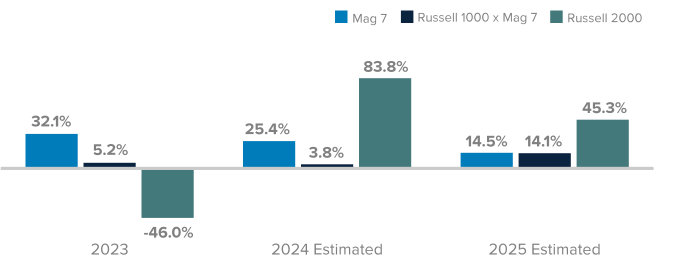
Notwithstanding currently cheap relative valuations, we are often asked what will trigger a lasting small-cap run that will end this period of relative underperformance. We think the answer may lie in the unfolding earnings story taking place in small-caps. As active small-cap managers, we have always believed that psychology runs the market in the short term—but earnings run the market in the long term. Small-cap earnings over the past year were disappointing, declining more than -10% in 2023, while large-cap earnings, driven by the Magnificent 7, were robustly positive.
Our expectation is that this dynamic will begin to reverse itself later this year as small-cap profits continue to recover via back-end loaded growth in 2024 and into 2025. This recovery is clearly evident in net income growth estimates for the Magnificent 7, the Russell 1000 (excluding the Magnificent 7), and the Russell 2000 for 2024 and into 2025, turning a significant small-cap headwind into a tailwind.
Exhibit 2: Net Income for 2023 with Estimates for 2024 and 2025
For the Magnificent 7, the Russell 1000 Index (excluding the Magnificent 7), and the Russell 2000
Source: FactSet. Past performance is no guarantee of future results.
As our friend Jim Furey of Furey Research likes to say, “Compelling relative valuation may not be a sufficient condition for a small-cap cycle, but it is an absolutely necessary one.” So, too, we believe is earnings growth. Our contention that equity market returns are going to broaden is rooted in the expectation that small-cap earnings should begin to accelerate in the second half of 2024 and continue into 2025. The earnings prospects for many small-cap companies remain promising and unrecognized, specifically those for businesses with sound fundamentals, such as low-debt balance sheets, positive cash flows, and the ability to pass on higher costs in this inflationary period. We believe that active management will become even more important in this market and that earnings will ultimately drive individual company stock returns.
Stay tuned…
Definitions
The Russell 1000 Index is an unmanaged, capitalization-weighted index of domestic large-cap stocks. It measures the performance of the 1,000 largest publicly traded US companies in the Russell 3000 Index.
The Russell 2000 Index is an index of domestic small-cap stocks that measures the performance of the 2,000 smallest publicly traded US companies in the Russell 3000 Index.
Enterprise value (EV) refers to the entire value of a company after taking into account both holders of debt and equity.
The EV/EBIT multiple is the ratio between enterprise value (EV) and earnings before interest and taxes (EBIT).
Magnificent 7 data refers to the following set of stocks: Microsoft (MSFT), Amazon (AMZN), Meta (META), Apple (AAPL), Google parent Alphabet (GOOGL), Nvidia (NVDA), and Tesla (TSLA). There is no assurance that any estimate, forecast or projection will be realized.
WHAT ARE THE RISKS?
All investments involve risks, including possible loss of principal. Past performance is no guarantee of future results. Please note that an investor cannot invest directly in an index. Unmanaged index returns do not reflect any fees, expenses or sales charges.
Equity securities are subject to price fluctuation and possible loss of principal.
Small- and mid-cap stocks involve greater risks and volatility than large-cap stocks.
Fixed-income securities involve interest rate, credit, inflation and reinvestment risks, and possible loss of principal. As interest rates rise, the value of fixed income securities falls.
International investments are subject to special risks including currency fluctuations, social, economic and political uncertainties, which could increase volatility. These risks are magnified in emerging markets.
Commodities and currencies contain heightened risk that include market, political, regulatory, and natural conditions and may not be suitable for all investors.
US Treasuries are direct debt obligations issued and backed by the “full faith and credit” of the US government. The US government guarantees the principal and interest payments on US Treasuries when the securities are held to maturity. Unlike US Treasuries, debt securities issued by the federal agencies and instrumentalities and related investments may or may not be backed by the full faith and credit of the US government. Even when the US government guarantees principal and interest payments on securities, this guarantee does not apply to losses resulting from declines in the market value of these securities.
Any companies and/or case studies referenced herein are used solely for illustrative purposes; any investment may or may not be currently held by any portfolio advised by Franklin Templeton. The information provided is not a recommendation or individual investment advice for any particular security, strategy, or investment product and is not an indication of the trading intent of any Franklin Templeton managed portfolio. Past performance does not guarantee future results.
Data and figures quoted in this article sourced from Russell Investments, Bloomberg and Reuters.