
in total AUM
Bonds aren’t all equal
Not all fixed income holds up when conditions change
Many investors buy bonds for income and stability, assuming it will naturally shelter their portfolio when markets turn stormy. But not all bond portfolios are truly diversified, and some conventional fixed income exposures can still carry concentrated risk and volatility. That’s the gap the Franklin Diversified Income Fund aims to fill—looking beyond traditional approaches to uncover a broader range of income.
We invest differently
We go beyond the usual playbook
Income investing often follows a familiar formula, using broad sector groupings, benchmark constraints and market calls to shape portfolios. The Fund takes a more flexible route, combining security selection with differentiated portfolio construction. It is not tied to a benchmark or built around leverage as a main source of return.
| TYPICAL APPROACH | OUR APPROACH | |
|---|---|---|
| Manages risk relative to a benchmark |
|
|
| Reliance on interest rate direction |  |
|
| Uses leverage or derivatives | |
|
| Flexible, not restricted by a benchmark | |
 |
| Generates alpha from security selection/sector allocation | |
|
| Seeks increased alpha via portfolio construction | |
|
| Diversifies across different balance sheets | |
|
| Mitigates drawdowns when markets fall | |
|
| Lower drawdowns Higher returns |
For illustrative purposes only. There is no guarantee an investment strategy will be successful.
Know beyond obvious
Know what broad labels miss
A single bond label can hide very different sources of risk. The investment team uses a proprietary framework that reorganises the bond universe into more than 20 custom sectors based on spread volatility, which reflects how different securities actually behave as market conditions change. This finer lens helps the team identify opportunities more precisely and shape the portfolio with greater control.
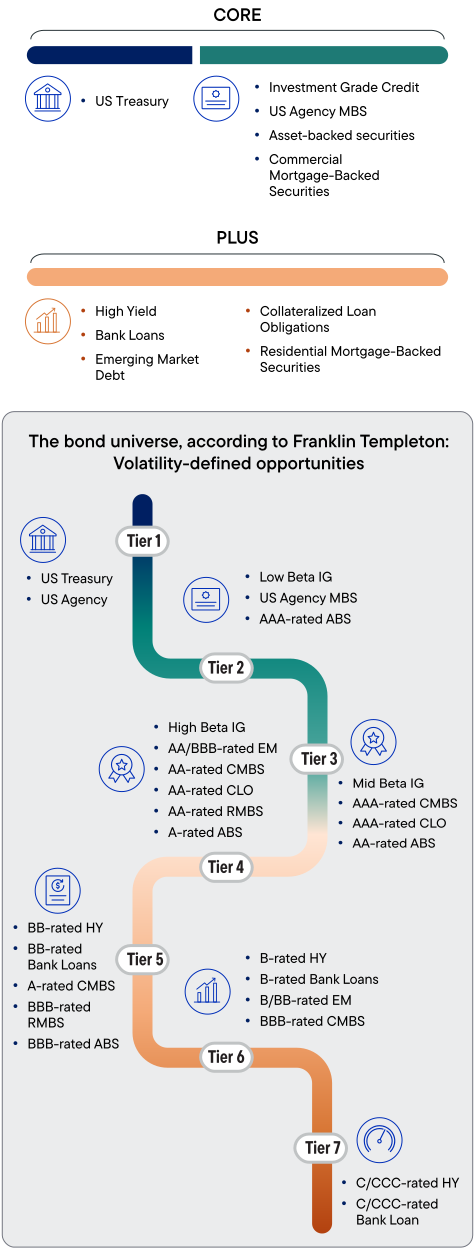
Note: Each tier represents a different level of risk and return, so the fund portfolio allocates more precisely across opportunities.
”IG” refers to investment-grade bonds; “MBS” refer to mortgage-backed securities; “US Agency MBS” refers to US agency mortgage-backed securities, which are investment-grade bonds backed by home loans and guaranteed by government-sponsored enterprises. “CMBS” refers to commercial mortgage-backed securities; “RMBS” refers to residential mortgage-backed securities; “CLO” refers to collaterised loan obligations; “HY” refers to high yield bonds; and “EM” refers to emerging market debt.
For illustrative purposes only. The information provided is not a recommendation to purchase, sell or hold any particular security. References to particular industries, sectors or companies are for general information and are not necessarily indicative of a fund’s holding at any one time.
Bonds move differently
Bonds don’t always diversify like you think
Looking beyond labels also means understanding how different bond segments behave relative to broader markets. For instance, since 2014, investment grade credit and high yield have shown correlations of 0.67 and 0.74 respectively to the S&P 500 Index, while asset-backed securities have shown much lower correlations of 0.11. By combining such differentiated sources of return, the Fund is designed to support a more consistent return profile over time.
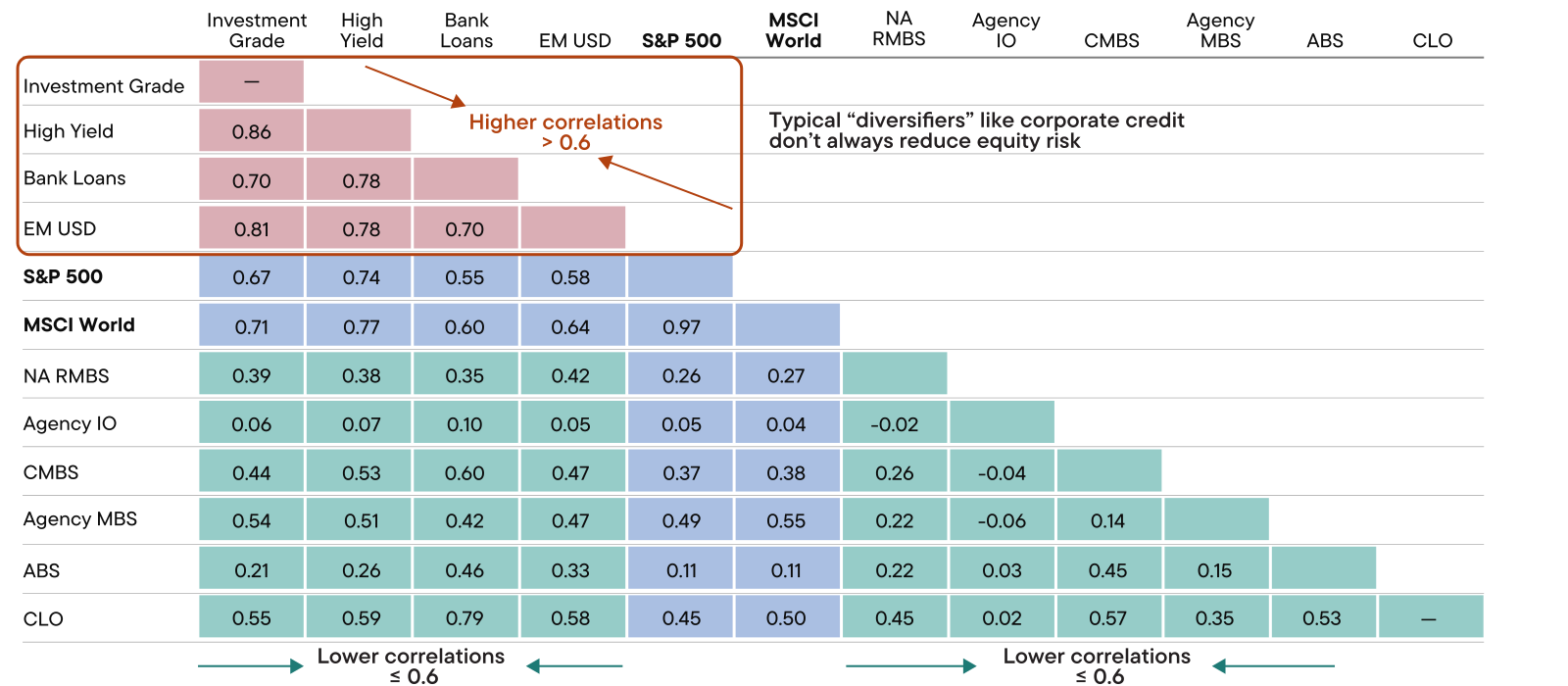
Source: Bloomberg, ICE Data Indices, JP Morgan Research, Franklin Templeton Fixed Income as of 31 December 2025. Investment Grade is represented by Bloomberg US Corporate Index, High Yield is represented by Bloomberg US High Yield Index, Bank Loans is represented by Morningstar LSTA Leveraged Loan Index, EM USD is represented by Bloomberg Emerging Market USD Sovereign Index, S&P 500 is represented by S&P 500 Index, Agency IO is represented by ICE BofA US Agency CMO Structured IO Index, CMBS is represented by ICE BofA Single-A US Fixed Rate CMBS Index, Agency MBS is represented by Bloomberg US MBS Index, ABS is represented by Bloomberg ABS Index, and CLO is represented by JPM CLO IG Index. Indices are unmanaged, and one cannot invest directly in an index. They do not reflect any fees, expenses or sales charges.
Past performance is not a guarantee of future results. Diversification does not assure a profit or protect against loss. It is possible to lose money in a diversified portfolio.
For illustrative purposes only. There is no guarantee an investment strategy will be successful. References to particular industries, sectors or companies are for general information and are not necessarily indicative of a fund’s holding at any one time.
Best minds, better outcomes
Best ideas need a strong foundation
A strategy like this is only possible with the depth of a firm that has invested through many market cycles and across a wide opportunity set. Franklin Templeton has partnered with clients for decades, bringing fixed income expertise shaped by experience and perspective that endures.
US $1.7tn
75+
years of track record
150
countries with clients
31*
years of average industry experience
Meet our investment team
The Fund is managed by a senior team whose expertise spans macro and multi-sector investing, high yield, securitised credit and emerging market debt. Together, they bring specialist judgement from across the bond market to shape a best-ideas portfolio rather than a one-size-fits-all allocation. That combination of skills is central to how the Fund seeks income while managing risk.

Sonal Desai, Ph.D.
Chief Investment Officer
Dr. Sonal Desai oversees all of Franklin Templeton's Fixed Income teams. She joined the firm in 2009 and has been recognised by Barron’s, Forbes and Pensions & Investments as one of the most influential women in finance.

Michael V. Salm
Senior Vice President, Fixed Income, Portfolio Manager
Glenn Voyles, CFA
Senior Vice President, Director of High Yield
Nicholas Hardingham, CFA
Senior Vice President, Portfolio Manager, Research Analyst
A fixed income platform built for all conditions
Behind the portfolio managers is a broad fixed income platform—research, trading and risk expertise across sectors and regions—working like an all-weather umbrella. For investors, that means deep resources helping the fund navigate changing conditions, rain or shine.
*Investment professionals include portfolio managers, research analysts, research associates, investment support and executives of Franklin Templeton.
All data as of 31 March 2026.
Franklin Diversified Income Fund
Resources
Fund Factsheet
Recent Insights
As markets shift, staying informed matters. These articles offer timely perspectives on what’s driving income opportunities.
- Sonal Desai: On My Mind
- Macroeconomic views
- Global views
- Sector view
Sonal Desai: On My Mind


Macroeconomic views


Global views


Sector view


FAQs
Yes. Many traditional fixed income strategies can become heavily exposed to the same interest rate, credit or macroeconomic risks, even when they appear diversified on the surface.
Assets that move too closely together may offer less protection during periods of volatility. Lower correlations across income sources can help create more resilient portfolios across changing conditions.
The Fund is not managed against a traditional benchmark and is not limited to broad sector allocations. Instead, it uses flexible portfolio construction and security selection to uncover differentiated income opportunities across global bond markets.
Securitised bonds are often influenced by different drivers than traditional government or corporate debt. This can help broaden portfolio exposures and potentially improve resilience during periods of market stress.
The strategy combines diversified sector exposure with a disciplined risk framework focused on duration, volatility and drawdown management. Ongoing stress testing and risk monitoring are integrated into the portfolio construction process.
The Fund invests across a range of income-producing fixed income sectors including corporate bonds, securitised assets and emerging market debt. This diversified approach seeks to create multiple sources of income rather than relying heavily on a single sector or market environment.
Important Legal Information
This fund meets the requirements under Article 6 of the EU Sustainable Finance Disclosure Regulation (SFDR); the fund does not promote environmental and/or social characteristics or have a sustainable investment objective under EU regulations.
This material is intended to be of general interest only and should not be construed as investment advice. It does not constitute legal or tax advice and it is not an offer for shares or an invitation to apply for shares of the Luxembourg-domiciled SICAV Franklin Templeton Investment Funds (the "Fund” or “FTIF"). For the avoidance of doubt, if you make a decision to invest, you will be buying units/shares in the fund and will not be investing directly in the underlying assets of the fund.
Franklin Templeton (“FT”) provides no guarantee or assurance that the Fund’s investment objective will be attained. The value of shares in the Fund and income received from it can go down as well as up, and investors may not get back the full amount invested. Past performance is not necessarily indicative nor a guarantee of future performance of the Fund. Currency fluctuations may cause the value of a Fund’s investments to diminish or increase.
FT shall not be liable to any user of this document or to any other person or entity for the inaccuracy of information or any errors or omissions in its contents, regardless of the cause of such inaccuracy, error or omission. Any opinions expressed are the author's at publication date and they are subject to change without prior notice. Any research and analysis contained in this material has been procured by FT for its own purposes and is provided to you only incidentally. Data from third party sources may have been used in the preparation of this document and FT has not independently verified, validated or audited such data.
No shares of the Fund may be directly or indirectly offered or sold to residents of the United States of America. Shares of the Fund are not available for public distribution in all jurisdictions and prospective investors, who are not financial professionals, should consult their financial advisor before deciding to invest. The Fund may use or invest in financial derivatives or other instruments which may entail specific risks more fully described in the Fund’s Documents.
Subscriptions may only be made on the basis of the most recent Prospectus and Product Highlights Sheet which is available at Templeton Asset Management Ltd or authorised distributors of the Fund. Potential investors should read the details of the Prospectus and Product Highlights Sheet before deciding to subscribe for or purchase the Fund. This shall not be construed as the making of any offer or invitation to anyone in any jurisdiction in which such offer is not authorised or in which the person making such offer is not qualified to do so or to anyone to whom it is unlawful to make such an offer.
In addition, a Summary of Investor Rights is available from Summary of Investor Rights (franklintempleton.sg). The summary is available in English.
The sub-funds of FTIF are notified for marketing in multiple EU Member States under the UCITS Directive. FTIF can terminate such notifications for any share class and/or sub-fund at any time by using the process contained in Article 93a of the UCITS Directive.
The value of investments and the income from them can go down as well as up and you may not get back the full amount that you invested.
Investors may wish to seek advice from a financial adviser before making a commitment to invest in shares of the Fund. In the event an investor chooses not to seek advice from a financial adviser, he/she should consider whether the Fund is suitable for him/her.
This advertisement or publication has not been reviewed by the Monetary Authority of Singapore.
Issued by Templeton Asset Management Ltd, Registration Number (UEN) 199205211E.
CFA® and Chartered Financial Analyst® are trademarks owned by CFA Institute.